

Nutrition Guide for Personal Training: Why Your Diet Matters As Much As Your Workouts
Showing up to your sessions is only half the equation. Whether you’re training in-person at your condo gym, working with a partner, or coaching online, what you eat outside the gym determines whether your training actually shows up as results. This nutrition guide for personal training breaks down the basics our coaches at Fit With Gopal walk every client through, in the same order we’d cover it in your first session.
Step 1: Find Your Maintenance Calories (TDEE)
Before you can cut, bulk, or recomp, you need a baseline. Your Total Daily Energy Expenditure (TDEE) is the number of calories your body burns in a day at your current weight and activity level. We calculate this for every new client using the Mifflin-St Jeor formula, the same equation researchers still consider one of the most accurate predictors of resting metabolic rate.
You don’t need to do this math by hand — our free Calorie Calculator gives you your maintenance, cut, and bulk numbers in seconds.
Step 2: Adjust Based on Your Goal
Once you know your maintenance number, the adjustment is simple:
- Fat loss: eat roughly 15–20% below maintenance. Bigger cuts feel faster short-term but usually cost you muscle and energy for training.
- Muscle building: eat roughly 10–15% above maintenance. Anything more just adds fat without speeding up muscle growth.
- Body recomposition: stay close to maintenance and let training and protein intake do the work of shifting your body composition over time.
Step 3: Prioritize Protein
Of the three macronutrients, protein is the one most worth tracking closely. Most active adults training for muscle building or fat loss do best around 1.6–2.2g of protein per kilogram of bodyweight per day, in line with the International Society of Sports Nutrition’s position stand on protein intake. Hitting this range consistently matters more than any specific meal timing or supplement.
Step 4: Keep the Rest Simple
Carbs fuel your training sessions and recovery; fats support hormone health — neither needs to be feared or eliminated. Beyond hitting your calorie and protein targets, the highest-leverage habits are the boring ones: drinking enough water, eating mostly whole foods, and staying consistent week to week rather than chasing a “perfect” day.
How a Personal Trainer Helps With Nutrition, Not Just Workouts
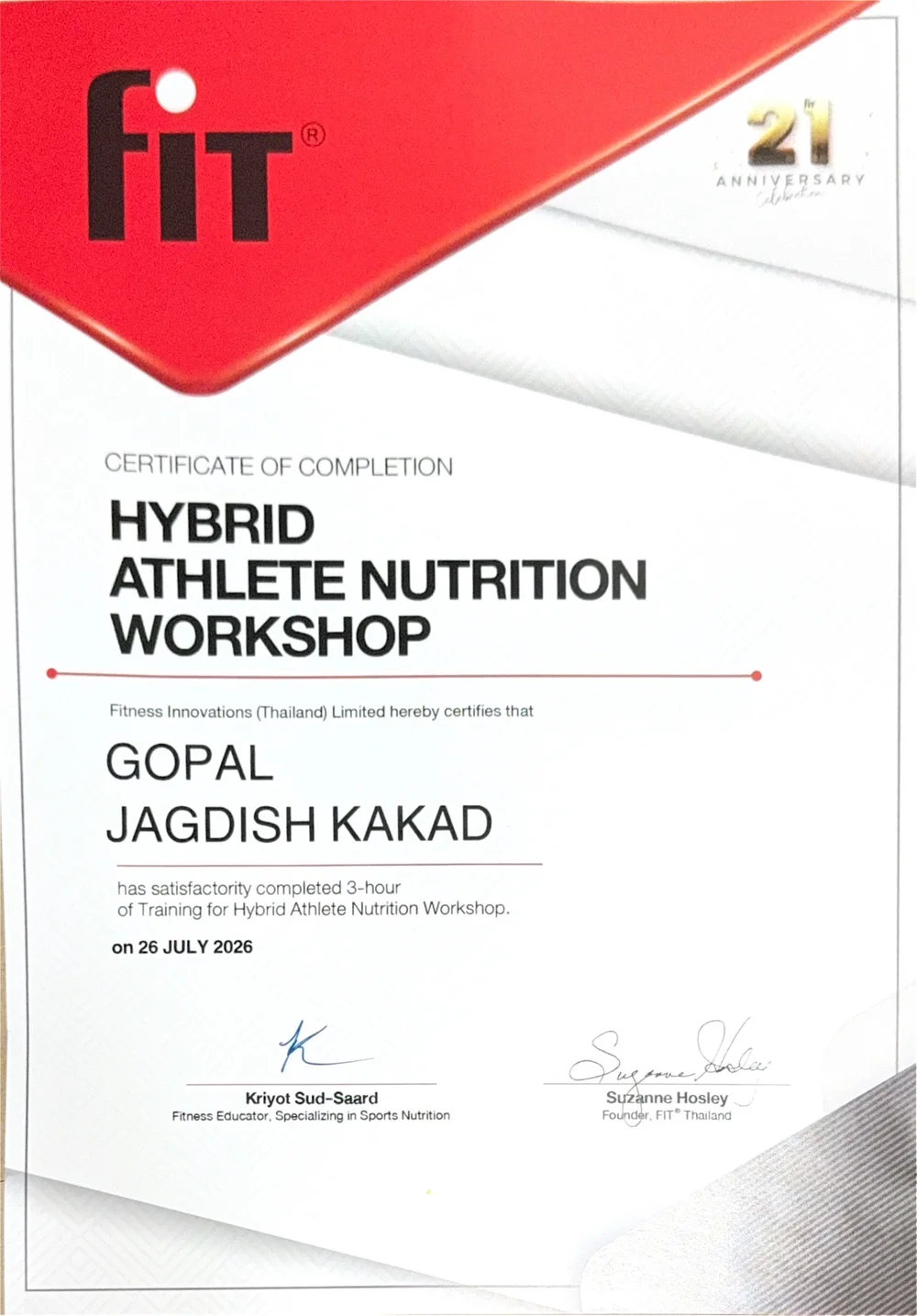
All three coaches at Fit With Gopal — Gopal, Notty, and Ro-ed — have completed FIT (Fitness Innovations Thailand)’s Hybrid Athlete Nutrition Workshop, so nutrition coaching is built into every in-person, online, and partner training package — not sold as a separate add-on. That means practical guidance on your calorie targets, protein intake, and everyday food choices alongside your programming, not a generic PDF meal plan.
Ready to Put This Into Practice?
Use the Calorie Calculator to get your numbers, then explore One-on-One, Online, or Partner training, or get in touch for a free trial session to talk through your goals in person.